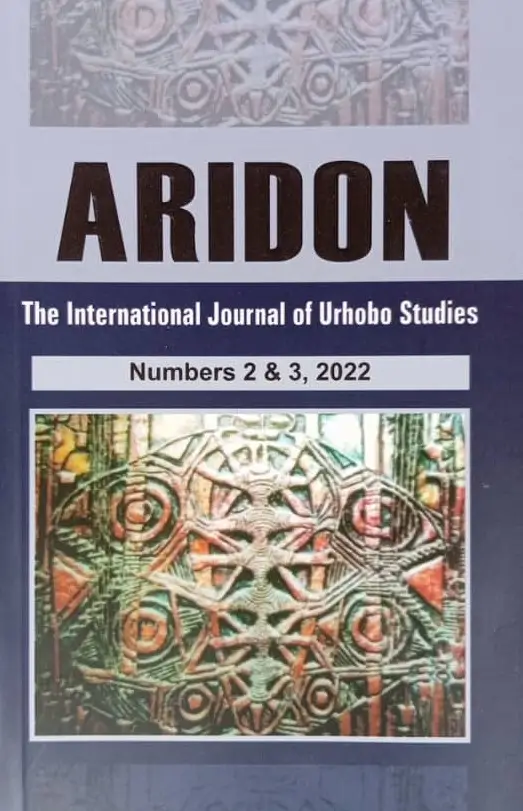
ARIDON: The International Journal of Urhobo Studies publishes well-researched and original papers on all aspects of Urhobo Studies: Language and Literature Studies, Linguistics, Theatre and Media Arts, Peace Studies, Conflict Studies, Niger Delta Studies, Gender Studies, Anthropology, Archaeology, Religious Studies, Philosophy, Law, Education, Sciences, Engineering, Technology, Economics, Environment, History, Politics, Diasporic Studies, Music, Fine Arts, Popular and Folk Cultures, Urhobo in Nollywood, Fashion, Food, Agriculture and Agronomy, etc. The journal strives for an interdisciplinary approach to research and scholarship which will create the platform for a common ground for scholarship and research on Urhobo and the world with Urhobo as the foundation for such intellectual inquiries. Comparative studies on Urhobo and other groups, especially the broader Pan-Edo world, are also considered for publication.
Editorial Note
We are delighted to publish the fifth edition of ARIDON barely a year after the fourth in 2025. This is a signal of the resurgence of the journal following long seasons of 'silence' between 2014 and 2022. This edition may be tagged 'Special' on account of the diversity of subjects and discourses covered.In September 2025, the Conference on "Twenty Years of Urhobo Studies" was held at the Delta State University, Abraka. It was organised by the Urhobo Studies Association (USA), and the Urhobo Historical Society (UHS). The convening of the conference marked a turning point in the annals of Urhobo scholarship. The conference attracted specialists from various academic and socio-cultural institutions; their presentations and engagements highlighted the significance of inter-disciplinary perspectives and discourses on the Urhobo people. The majority of articles featured in this edition of ARIDON are chosen from the harvest of presentations. The conference also revealed that there is a vast body of Urhobo knowledge awaiting diligent research and documentation. This is an auspicious indicator of the bright future for Urhobo intellectual development. We are indepted to various sponsors of the historic gathering of scholars, particularly the Delta State University, Abraka, that offered generous financial support as well as facilities. The Urhobo have a rich experience in the management of convocations of periodic festivals (Ore), a season of the year during which our people review their history and culture, evaluate their socio-economic affairs, venerate ancestral roots and figures, analyse challenges, exhibit areas of achievement, as well as entertain and renew themselves in aesthetic and spiritual terms. The 2025 Conference was an academic version of the traditional festival institution for which the Urhobo have been known and appreciated over the millennia.It is also remarkable that this edition of ARIDON features several studies related to the domains of scientific and technical uniqueness of the Urhobo experience. There are exciting analyses on the technology and economy of fisheries and aquaculture, advances in computer and digital communication and the puzzles it poses for the Urhobo language. There are also insights on microbial and marketing issues in popular cuisines, the science of names and naming, Erinvwin and related cosmic,philosophical inquiries about ethical and moral conduct. From the repertoire of folktales and their aesthetico-ethical concerns, their narratology and egalitarian principles are revisited in this edition. No less significant are perspectives on the infrastructure and management of festival events - ancient and contemporary.In both ukodo and oghwo-evwri formulations, our Editorial Collective is happy to offer these ARIDON festival dishes of diverse and innovative discourses on Urhobo experiences and knowledge sites.Tanure OjaideGodini G. DarahRose Oro Aziza

We are delighted to publish the fifth edition of ARIDON barely a year after the fourth in 2025. This is a signal of the resurgence of the journal following long seasons of 'silence' between 2014 and 2022. This edition may be tagged 'Special' on account of the diversity of subjects and discourses covered. In September 2025, the Conference on "Twenty Years of Urhobo Studies" was held at the Delta State University, Abraka. It was organised by the Urhobo Studies Association (USA), and the Urhobo Historical Society (UHS). The convening of the conference marked a turning point in the annals of Urhobo scholarship. The conference attracted specialists from various academic and socio-cultural institutions; their presentations and engagements highlighted the significance of inter-disciplinary perspectives and discourses on the Urhobo people. The majority of articles featured in this edition of ARIDON are chosen from the harvest of presentations. The conference also revealed that there is a vast body of Urhobo knowledge awaiting diligent research and documentation. This is an auspicious indicator of the bright future for Urhobo intellectual development. We are indepted to various sponsors of the historic gathering of scholars, particularly the Delta State University, Abraka, that offered generous financial support as well as facilities. The Urhobo have a rich experience in the management of convocations of periodic festivals (Ore), a season of the year during which our people review their history and culture, evaluate their socio-economic affairs, venerate ancestral roots and figures, analyse challenges, exhibit areas of achievement, as well as entertain and renew themselves in aesthetic and spiritual terms. The 2025 Conference was an academic version of the traditional festival institution for which the Urhobo have been known and appreciated over the millennia. It is also remarkable that this edition of ARIDON features several studies related to the domains of scientific and technical uniqueness of the Urhobo experience. There are exciting analyses on the technology and economy of fisheries and aquaculture, advances in computer and digital communication and the puzzles it poses for the Urhobo language. There are also insights on microbial and marketing issues in popular cuisines, the science of names and naming, Erinvwin and related cosmic, philosophical inquiries about ethical and moral conduct. From the repertoire of folktales and their aesthetico-ethical concerns, their narratology and egalitarian principles are revisited in this edition. No less significant are perspectives on the infrastructure and management of festival events - ancient and contemporary. In both ukodo and oghwo-evwri formulations, our Editorial Collective is happy to offer these ARIDON festival dishes of diverse and innovative discourses on Urhobo experiences and knowledge sites.
This study examines the equivalence of computer-related terms developed for the Urhobo language. Rapid advancement in technology continues to introduce terms for new concepts which are often lacking in many indigenous African languages, including Urhobo. Accordingly, indigenous scholars and researchers often undertake terminology development projects to fill such gaps. The Urhobo ICT terminology development project examined in this study sought to contribute to the modernisation of the Urhobo language by expanding its lexical resources to cover the rapidly evolving domain of computer technology. The project involved identifying corpus of frequently used computer words from textbooks and online resources and developing equivalent terms for them in Urhobo. The goal of the present study is to examine the strategies employed in creating the Urhobo equivalent terms, and show how possible equivalent terms can be developed from existing Urhobo lexical resources. The study found that strategies such as semantic extension, norminalisation, and calquing were employed in developing the terms. The study also showed that loanwords can be retained in Urhobo terminology development based on three factors: frequency of usage in conversations, economy and convenience.
This review examines the transformation of inland fisheries in Urhobo land, located in the western Niger Delta, from historically productive and culturally significant systems centred on traditional fish aggregating structures (ewẹ) to a present-day dependence on imported iced marine fish (okweko). Drawing on historical accounts, cultural records, ecological observations, and relevant scientific literature, the paper synthesises evidence on the cultural and nutritional importance of fish, the diversity and productivity of traditional fisheries, and the socio-economic systems they supported. The review identifies multiple drivers of decline, including habitat degradation, occasional chemical fish poisoning, pollution from oil and industrial sources, hydrological alterations, and the erosion of intergenerational knowledge transfer. It discusses the sociocultural and economic implications of this decline, highlighting its impact on food security, cultural identity, and local resilience. Based on lessons from global experiences, the review outlines integrated strategies for recovery, including habitat rehabilitation, revitalisation of owẹ, scientifically managed stock enhancement, household-level aquaculture using borehole water, market restructuring, and improved governance frameworks. The synthesis underscores that restoration of inland fisheries in Urhobo land is achievable if pursued through coordinated actions that combine environmental management, technological innovation, and cultural preservation, thereby ensuring nutritional, economic, and cultural sustainability.
The digital revolution is reshaping how cultures are preserved, transmitted, and represented. For the Urhobo people, whose identity is deeply tied to oral traditions, language, and communal practices, the rise of ICT, social media, and artificial intelligence presents both unprecedented opportunities and serious risks. This paper examines how digital platforms and AI technologies are influencing Urhobo studies, language preservation, and cultural expression in the 21st century. The paper interrogates the role of social media in amplifying Urhobo voices globally, while also assessing how algorithmic biases and digital homogenization may marginalize indigenous knowledge. The paper explores AI-driven tools for Urhobo language documentation and translation, alongside community-led initiatives using ICT to sustain music, festivals, and oral heritage. It argues that integrating Urhobo epistemologies into the digital sphere is not merely about preservation but about innovation positioning, Urhobo culture as an active contributor to the evolving global digital humanities. By bridging tradition and technology, this study demonstrates that the future of Urhobo identity lies in harnessing digital power responsibly, ensuring thatAI and ICT become tools of empowerment rather than erasure.
In earlier eras, Urhobo knowledge systems proved remarkably resilient, adapting to colonial disruption and the extractive pressures of the oil economy. From iron smelting (Eghwu) to oral historiography, these epistemologies provided continuity and identity despite external shocks. The Fourth Industrial Revolution (4IR), however, poses challenges of a different order. Digital language erosion, data colonialism, and the marginalization of non-Western techno-epistemologies now threaten Urhobo heritage in unprecedented ways. This study examines how Urhobo knowledge systems are responding to these transformations. Using historical analysis, ethnographic inquiry, and targeted case studies—including AI-driven language preservation projects and blockchain registries for Urhobo cultural heritage – the study highlights the paradoxes of technological adoption. On one hand, Urhobo youth embrace digital tools for cultural expression; on the other, infrastructural inequities and culturally insensitive designs limit their reach and sustainability. Drawing on the metaphor of Ukodo—a traditional pottage in which each ingredient retains its distinctiveness yet contributes to the collective nourishment—the paper argues that safeguarding Urhobo epistemologies is not merely about data storage but about integrating the diverse elements of tradition, governance, and technology in balanced, relational ways. Just as Ukodo's flavour emerges from careful, participatory preparation, so too must 4IR tools be 'stewed' with Urhobo values of reciprocity, community custodianship, and ancestral respect. The findings suggest that technologies alone cannot safeguard Urhobo epistemologies. A decolonial framework is required—one that includes community-led digital archives to ensure local custodianship, ethically designed AI guided by Ovie principles of governance, and policy reforms that foreground Urhobo stakeholders within Nigeria's digital economy. Such measures demonstrate how indigenous epistemologies can shape, rather than merely survive, global technological shifts. The conclusion is clear: without a reflexive integration of Urhobo cosmologies—the Ukodo-like blending of old and new—the 4IR risks repeating older cycles of cultural dispossession. Yet if strategically engaged, it may open a pathway to epistemic justice, offering lessons not only for Urhoboland but for global debates on indigenous knowledge in the digital age.
This study investigates the microbial quality and proximate composition of commonly consumed ready-to-eat roadside snacks sold in Abraka and Agbor, two major urban centres in Delta State, Nigeria. A total of selected snack samples, such as roasted groundnuts, akara (bean cake), meat pie, puff-puff, and fried fish, were aseptically collected from different vendors in both locations. Microbial evaluation was carried out using standard microbiological procedures to determine total viable bacterial count, fungal count, and the presence of indicator and pathogenic organisms. Proximate analysis (moisture, ash, crude protein, crude fat, crude fibre, and carbohydrate content) was conducted using AOAC standard methods. Results revealed varying microbial loads among the samples, with some exceeding acceptable limits for ready-to-eat foods, particularly those exposed to dust, poor handling, and inadequate storage. Identified microorganisms included Staphylococcus aureus, Escherichia coli, Bacillus spp., and assorted fungal species, indicating potential contamination from handling, environment, and processing equipment. Proximate composition also varied significantly among the snacks, reflecting differences in ingredients and preparation methods. Snacks with higher moisture content showed correspondingly higher microbial counts. The study underscores the public health implications of consuming poorly handled roadside foods and highlights the need for improved hygiene practices among vendors, regular monitoring by health authorities, and increased consumer awareness. It also provides baseline data useful for food safety assessment in Abraka, Agbor, and similar urban settings.
This study explores the semantics of naming practices emanating from the social, traditional, and cultural contexts surrounding the birth of children among the Urhobo people of Nigeria's Niger Delta region. Drawing from the field of onomastics, the study of names and naming, the research examines how the Urhobo use naming as a means of expressing joy, commemorating memorable events, processing trauma, asserting identity, and preserving collective memory. Urhobo culture and traditions transcend mere semantic representation by embedding profound meanings that reflect the community's history, values, beliefs, and social structures. The Urhobo naming system vividly encapsulates how names convey messages about identity, lineage, birth circumstances, gender, and shared experiences. The study analyses selected names given to children in response to specific socio-cultural experiences, highlighting the emotional, cultural, and political meanings embedded in them. Through qualitative data gathered from interviews, oral histories, and linguistic analysis, the research demonstrates how these names function as tools of social commentary and as markers of socio-political and cultural preservation. Ultimately, the paper contributes to broader discussions on gendered onomastics, colonial and postcolonial identity, and the role of linguistic practices in the Niger Delta, a resource-rich yet historically marginalized region of Nigeria.
This article examines Erinvwin as the central moral arbitrator within Urhobo religious worldview, arguing that it functions as an indigenous institution of justice rooted in ancestral authority rather than in divine worship or human legal systems. Among the Urhobo of the Niger Delta, Nigeria, moral order is sustained through the belief that the ancestors, resident in Erinvwin, continue to observe, judge, and sanction the conduct of the living. Historically, Erinvwin operated as an incorruptible tribunal invoked in cases of adultery, theft, perjury, and land disputes, particularly where human judgment was inadequate or vulnerable to manipulation. Drawing on qualitative data from oral testimonies, proverbs, and indigenous narratives, as well as relevant Africana religious scholarship, the study analyses how Erinvwin regulated ethical behaviour, enforced truth-telling, and preserved communal harmony. The study further explores the impact of Christianity, Islam, and modern legal institutions on Erinvwin's authority, showing that while its ritual invocation has declined, its moral influence persists through cultural memory, language, and ethical instruction. Rather than disappearing, Erinvwin has become a symbolic moral conscience that continues to shape Urhobo notions of accountability and justice. The article concludes that Erinvwin remains a vital resource for understanding indigenous African contexts of morality and offers important insights into the resilience of Africana religious ethics in the face of modern socio-religious change.
This paper analyses three poems by Atiboroko Uyovbukerhi's–'Ọrhare' (bachelor), 'The market', and 'Ukodo' to explore their reflection of the Urhobo worldview. Through a qualitative analysis, this study examines how these poems capture the complexities of relationships, the transient nature of life, and the importance of communal effort. The findings highlight the poet's nuanced portrayal of Urhobo cultural values and philosophical perspectives, revealing the intricate dynamics of societal expectations, individual aspirations, and communal responsibilities. The market metaphor in 'The Market' serves as a poignant reminder of life's journey, where individuals meet, share experiences, and part ways. The exploration of destiny in 'Ọrhare' underscores the Urhobo belief in living to fulfil one's destiny, despite the unpredictable nature of life. 'Ukodo' emphasizes the value of communal effort and contribution, illustrating the Urhobo belief in the strength of unity and cooperation. By examining the poet's use of literary devices like imagery, metaphor, symbolism, simile, and rhetorical questions, this study demonstrates how Uyovbukerhi offers a profound insight into Urhobo worldview, emphasizing the significance of cultural heritage and traditional values The findings contribute to a deeper understanding of Urhobo literature and culture, shedding light on the Urhobo people's experiences, perspectives, and cultural identity. The study has implications for the appreciation of African worldviews through literature, providing a platform for cultural expression and preservation.
The folktale genre is one of the oldest forms of artistic reconstruction whose expression projects the people's culture and socio-political identity. Many of the tales in Africa reflect the experiences of the people, drawing on themes which address the myriads of the people's folkways, and reinforcing their quest for an egalitarian society. Thus many of the tales with human and animal motifs, explore abuse of power and condemn hegemonic institutions as well as expose oppression and injustice. This paper focuses on the socio-politcal idealisation of class system in two African folktales.It uses two Urhobofolktale texts as analytical materials. The descriptive-analytical method is adopted in this study. This method involves an in-depth description and analysis of the selected folktales to bring out the salient themes of socio-political reconstruction and class distinction. It adopts the Marxian theory which postulate that human society is constructed upon physical organisations and modes of relationships which serve as natural base for the construction of human history and their modifications in a bid to establish an egalitarian society. Through this theory, we are able to ascertain the fact that the infrastructures of African traditional society are linked to its economics for which the superstructure of politics, law and religion are established. The paper concludes that the storyteller (s), through his story(s), not only dubs as the cultural mediator between the people and their rulers but operates as the watchdogs of societies by commenting on negative sociopolitical appurtenances that are inimical to the progress of society.
Traditional festivals have been an integral part of human culture and society, servicing as a means of expressing cultural identity, promoting social cohesion and preserving cultural heritage. In many traditional societies, festivals are not mere celebrations, but are deeply rooted in the cultural, spiritual and historical contexts of the community. They provide a platform for the community to share experiences and reconnect with their ancestors and heritage. This study explores the significance of traditional festivals in reliving the ancestors among the Agbon - Urhobo people of Delta State. Agbon - Urhobo festivals serve as a means of connecting and honoring their legacies. Primary and secondary sources were used for the collection and collation of data. Findings reveal that Agbon - Urhobo traditional festivals provide a platform for the community to relive the past, reenact ancestral traditions and reconnect with their roots. The festivals serve as a means of cultural transmission, allowing younger generations to learn and appreciate their ancestral heritage.
The book, HRM Benjamin Okumagba: Portrait of a Neo-Nationalist, celebrates the exploits and accomplishments of the Okumagba Family of the Okere-Urhobo people of Warri metropolis, Nigeria. It is an epic story, a saga of a family unit whose vision and struggles for autonomy, identity and justice transformed and redefined the socio-political space of Warri and its environment in the last century. The thematic focus of the story is Chief Benjamin Okumagba, a scion of the progenitor homestead of three brothers: Idama, Ohwotemu, and Sohworuvwe. They migrated from Okpare in Olomu district of Urhobo to establish Okere-Urhobo several centuries ago. The book is a tribute to the members of the original family for their titanic and heroic deeds that created the dynasty exemplified by the charismatic personality of Benjamin Okumagba. The saga relates how the Okere-Urhobo people rose gallantly from the smoke and wreckage of turbulence and conflicts to build one of the most stable, dynamic, and prosperous sub-urban estates in the metropolis of Warri.
The publication of the book, The Ibru Story, is one of the most positive and inspiring news fromAfrica in the 21st century. This point is important because much of the news about Africa in the global media tends to project a continent where things permanently “fall apart” and where nothing works for the public good. This perception of Africa is deliberately distorted in order to cover up the truth about how the Western nations benefit from, and undermine our continent for their economic wellbeing. To the foreign predators and plunderers of African resources and misfortunes, nothing good is to be expected from Africa and its people. In millions of stories and images of Africa circulated around the globe since the end of Black Civilisations 2000 years ago, Africa is caricatured, mostly ignorantly, as a continent that is bound to violence and stagnation. Yet Africa, the cradle of humanity and the most colonized territory in history, is endowed with about 40% of the world's mineral wealth, an endowment that guarantees the prosperity of the industrialised nations. It is, therefore, appropriate that Mike Awoyinfa resolutely and robustly challenges this centuries-old propaganda with the salubrious story on the Ibru Dynasty of ingenious and prosperous investors.